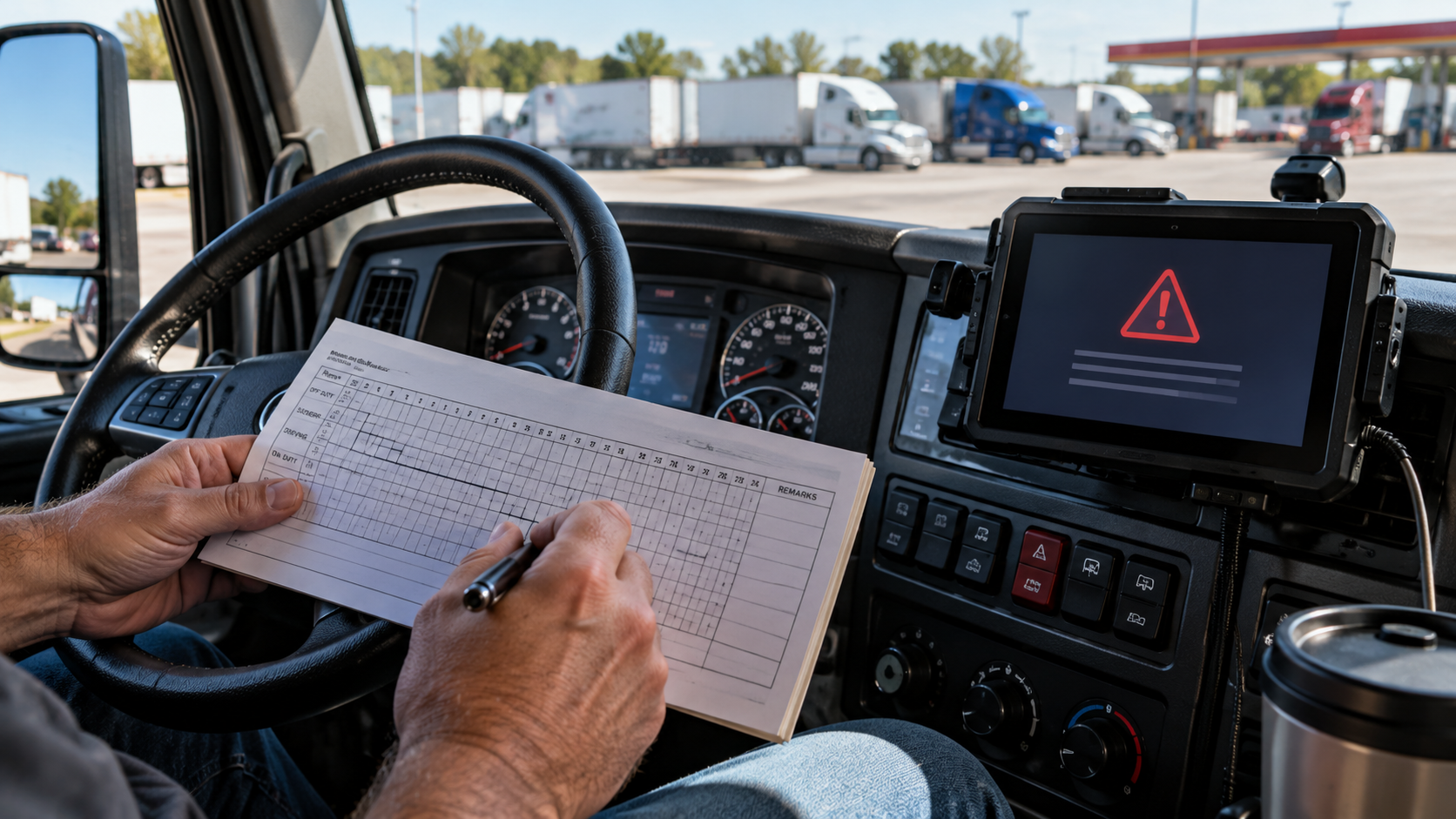
You're rolling down the highway, keeping an eye on your hours, when your electronic logging device suddenly freezes, disconnects, or displays a malfunction warning.
Now what?
Do you pull over and wait for somebody to fix it? Can you switch to paper logs? Can dispatch tell you to keep running? And how long can you legally operate without a functioning ELD?
These aren't questions drivers want to figure out for the first time during a roadside inspection.
Fortunately, the Federal Motor Carrier Safety Administration (FMCSA) has established procedures for ELD malfunctions. The requirements are found in 49 CFR 395.34, and they apply to drivers and motor carriers subject to the ELD regulations.
Here's what professional drivers need to understand.
First, Determine Whether Your ELD Has Actually Malfunctioned
Not every warning on an electronic logging device means the system has completely failed.
An ELD may display a data diagnostic event because of missing information, an unidentified driving event, or a temporary connection issue.
A malfunction is more serious. It can involve problems with the device's ability to record, retain, retrieve, or transfer required information.
If the device displays an error, follow the ELD provider's troubleshooting instructions and notify the appropriate person at your carrier.
The important distinction is whether the device can still accurately record your hours of service and make the required records available.
A temporary diagnostic warning does not automatically mean you must switch to paper logs.
You Have 24 Hours to Notify Your Carrier
Under 49 CFR 395.34, a driver must note an ELD malfunction and provide written notice to the motor carrier within 24 hours.
That notification should identify the malfunction and allow the carrier to begin addressing the problem.
Don't assume that mentioning the issue over the phone is sufficient documentation.
Use the carrier's established reporting procedure, whether that involves an electronic message, written report, or another approved method.
Keep a record of when you reported the problem.
This protects the accuracy of the timeline and helps establish when the carrier became aware of the malfunction.
When Paper Logs Become Necessary
If the malfunction prevents the ELD from accurately recording your hours of service, federal regulations require you to maintain compliant alternative records.
That generally means using graph-grid paper logs or compliant electronic logging software that meets the applicable recordkeeping requirements.
You must reconstruct your record of duty status for:
The current 24-hour period.
The previous seven consecutive days, unless those records are already available or can be retrieved from the ELD.
If you have access to your previous records, you do not necessarily have to rewrite every entry.
FMCSA guidance permits previously recorded logs to be presented in an acceptable printed or electronic format when the device cannot display them.
The objective is to maintain an accurate, complete record of your duty status.
An ELD malfunction does not eliminate your responsibility to account for your driving and on-duty time.
The Eight-Day Rule: How Long Can You Use Paper Logs?
This is where drivers sometimes get confused.
Federal regulations generally require the motor carrier to correct, repair, replace, or service the malfunctioning ELD within eight days of discovering the problem or receiving the driver's notification, whichever happens first.
During that period, the driver may use compliant alternative records when the malfunction prevents proper electronic logging.
However, this is not permission to operate indefinitely on paper logs.
Continuing to use paper logs beyond the permitted period without an authorized extension can result in enforcement action, including the possibility of being placed out of service.
The eight-day provision concerns the malfunction and its correction. It does not give a driver eight days of unrestricted driving.
Your normal hours-of-service limitations still apply.
Can the Carrier Request More Time?
Yes, but the extension process belongs to the motor carrier.
Under 49 CFR 395.34, a carrier may request additional time from FMCSA when the malfunction cannot be corrected within the standard period.
The request generally must be submitted to the appropriate FMCSA Division Administrator within five days after the driver's notification.
The carrier must provide the required information explaining the malfunction and the circumstances supporting the extension request.
A carrier requesting an extension is not the same as having one approved.
Drivers should not assume they can continue using paper logs beyond the normal period simply because someone says the company is working on the problem.
What Happens During a DOT Inspection?
Suppose your ELD quits working on Tuesday and you get inspected on Wednesday.
You still need to demonstrate compliance with the applicable hours-of-service regulations.
That means providing the records you've maintained during the malfunction, along with the required previous records.
An inspector may ask when the malfunction occurred, whether it was reported, and how you have been recording your duty status.
Accurate documentation is important.
If your ELD failed, you reported it, and you're maintaining compliant records within the permitted period, the regulations provide a procedure for handling that situation.
But incomplete logs, inaccurate records, or operating beyond the authorized malfunction period can create separate violations.
What About Dispatch?
Let's address something that happens in the real trucking world.
A driver reports that the ELD is malfunctioning, and somebody in the office responds, "Just keep going. We'll figure it out."
That instruction doesn't override federal regulations.
The driver remains responsible for complying with hours-of-service limits and maintaining accurate records.
The motor carrier has its own responsibilities to address the malfunction and ensure proper recordkeeping.
Both parties have obligations.
A malfunctioning ELD doesn't create extra driving hours, erase previous on-duty time, or authorize operating while fatigued.
If you're approaching an hours-of-service limit, you still need to plan accordingly.
Five Practical Steps When Your ELD Fails
- Document the problem. Note when the malfunction occurred and what the device displayed. Preserve any useful error information.
- Notify your carrier in writing. Do so within the required 24-hour period and retain evidence of the notification.
- Preserve your existing logs. Retrieve your current and previous seven days of records when possible.
- Maintain accurate alternative records. If the device can no longer properly record your hours, use compliant paper logs or another permitted method.
- Confirm the repair and compliance status. Don't assume the problem has been corrected simply because the display turns back on. Follow the provider's procedures and verify that required logging functions are working.
Why Every Driver Should Know This Before It Happens
An ELD malfunction rarely occurs at a convenient time.
It might happen halfway through a trip, at a shipper, or hundreds of miles from the carrier's terminal.
Knowing the procedure ahead of time prevents confusion and helps protect your driving record.
Keep the required ELD instruction materials accessible, know how to retrieve your logs, and understand how to contact your carrier when equipment fails.
Most importantly, remember that the electronic device is a recordkeeping tool. It doesn't replace the driver's responsibility to operate legally.
The Bottom Line
When your ELD quits working, you don't automatically have to abandon the trip. But you also can't ignore the malfunction.
Federal regulations establish a clear process: report the problem, preserve your records, maintain compliant logs, and make sure the equipment is corrected within the permitted timeframe.
The technology may fail.
Your responsibility to keep accurate hours-of-service records doesn't.
Official Federal References
49 CFR 395.34: ELD Malfunctions and Data Diagnostic Events
FMCSA: ELD Malfunctions and Data Diagnostic Events
FMCSA: ELD Carrier and Driver Training
This article provides general educational information about federal ELD requirements. Drivers and motor carriers should consult the current regulations and applicable FMCSA guidance for their specific circumstances.