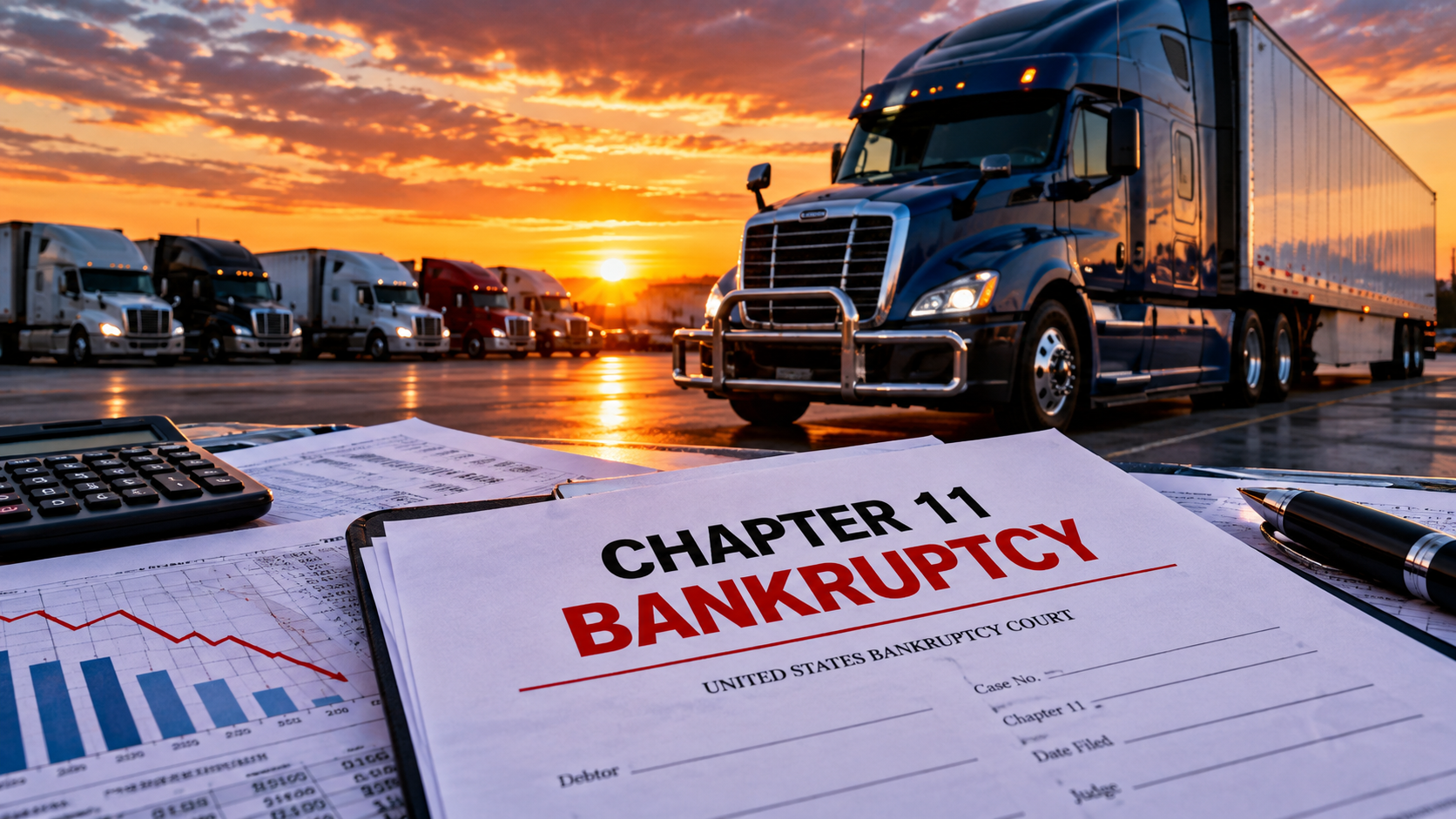
The American trucking industry is facing another difficult stretch, with recent bankruptcy filings affecting companies ranging from single-truck operators to fleets operating dozens of commercial vehicles.
According to a September 22 report by FreightWaves, at least 16 trucking, delivery, and transportation businesses filed for Chapter 7 or Chapter 11 bankruptcy between late August and September 21, 2026.
The filings involve companies operating in general freight, specialized transportation, agricultural hauling, and delivery services.
While the numbers raise concerns about financial conditions across the industry, the filings do not establish that every company has permanently closed or that fuel prices alone caused its financial difficulties.
Which Trucking Companies Have Filed?
Among the companies identified in recent bankruptcy reporting:
- Xoco Transport LLC, Hidalgo, Texas: Filed for Chapter 11 protection on September 16. Carrier records indicated more than 40 tractors and approximately 65 drivers.
- Globemaster Incorporated, Bolingbrook, Illinois: Filed for Chapter 11 on September 15. The company operated 51 power units and reported liabilities between $1 million and $10 million.
- CLJ Transporting Inc., Auburndale, Florida: Filed for Chapter 11 on September 15. The delivery operation was listed with 18 trucks and approximately 30 drivers.
- Jett Transport & Materials LLC, Somerset, Texas: Filed for Chapter 11 on September 14. Carrier records identified 14 trucks.
- C. Pride Transport Inc., Illinois: Filed for Chapter 7 on September 18. Carrier records identified a single-truck operation.
These examples demonstrate that financial distress is not limited to one particular fleet size or type of transportation business.
The reported group included eight Chapter 11 filings and eight Chapter 7 filings.
Bankruptcy Does Not Always Mean a Trucking Company Has Shut Down
There is an important distinction between the two types of bankruptcy proceedings.
Chapter 11 bankruptcy generally allows a business to seek financial reorganization under court supervision. A trucking company may continue operating while attempting to restructure its debts and obligations.
Chapter 7 bankruptcy generally involves liquidation, with assets potentially sold to satisfy creditor claims.
A Chapter 11 filing should not automatically be described as a permanent business closure.
Likewise, a bankruptcy filing does not establish wrongdoing by the company or its management.
Diesel Prices Add Another Financial Burden
Fuel is one of the largest operating expenses for commercial trucking businesses.
According to the U.S. Energy Information Administration, the national average on-highway diesel price was $6.199 per gallon on October 5, 2026.
Although that represented a decline from $6.529 on September 21, the October 5 price remained $2.488 per gallon higher than the same period a year earlier.
For a truck traveling 2,500 miles per week at an average of 6.5 miles per gallon, that year-over-year difference represents approximately $957 in additional weekly fuel expense.
If those conditions continued for an entire year at the same mileage, the additional fuel expense would approach $50,000 per truck.
That calculation is illustrative. Actual costs depend on mileage, fuel economy, fuel discounts, surcharges, routes, and operating arrangements.
For carriers operating multiple trucks, even modest changes in fuel costs can substantially affect operating budgets.
Why Smaller Carriers May Be Especially Vulnerable
A large trucking company may have greater access to fuel discounts, financing, established customer contracts, and financial reserves.
Smaller carriers and independent operators may have fewer options when expenses increase.
Some operate primarily in the spot freight market, where rates can change quickly and fuel surcharges may not be separately negotiated.
Consider a carrier that has already committed much of its revenue to equipment payments, insurance, maintenance, payroll, and other expenses.
When fuel prices rise, the company must either recover the additional expense through its freight rates, absorb the difference, or reduce other costs.
If freight revenue cannot keep pace, cash flow can deteriorate.
However, these pressures should not be confused with documented causes of individual bankruptcy cases. Determining why a specific company entered bankruptcy requires examining its financial circumstances and court filings.
The Pressure Extends Beyond Fuel
Diesel is only one part of the financial picture.
Trucking companies must also manage equipment financing, insurance premiums, maintenance, tires, employee compensation, regulatory compliance, and the time between delivering freight and receiving payment.
A company can have trucks moving freight every day and still experience financial difficulties if its expenses exceed the revenue those trucks generate.
The issue is not simply whether freight is available.
It is whether that freight produces enough revenue to support a financially sustainable operation.
What Does This Mean for Company Drivers?
For company drivers, the financial stability of an employer matters.
A carrier experiencing financial problems may face difficult decisions involving equipment, staffing, freight operations, or business restructuring.
But drivers should not assume that a company is about to close simply because it has filed for Chapter 11 protection.
Drivers who receive official notices concerning bankruptcy proceedings, payroll changes, or company operations should preserve their employment and compensation records and seek clarification through appropriate company or legal channels.
Bankruptcy proceedings can affect employees differently depending on the circumstances of the case.
Are Trucking Bankruptcies Increasing Nationwide?
The recent filings demonstrate that financial distress continues to affect trucking businesses.
However, 16 filings over a particular reporting period do not, by themselves, establish a nationwide increase in the bankruptcy rate.
That conclusion would require consistent comparisons across earlier periods, comparable business categories, and a broader set of bankruptcy records.
FreightWaves separately identified at least 21 transportation and supply-chain businesses seeking bankruptcy protection between July 27 and August 25. That broader group included logistics and distribution businesses beyond motor carriers.
The two figures should not be treated as directly comparable measurements of trucking-only bankruptcies.
What the reports do show is that financial distress has affected multiple segments of the freight economy over successive months.
The Bottom Line
The latest bankruptcy filings are another reminder that operating a trucking business involves far more than keeping a truck loaded and moving.
A carrier must generate enough revenue to cover its operating expenses, service its debts, maintain its equipment, and remain financially stable when market conditions change.
Higher diesel prices can make that challenge considerably more difficult, particularly for smaller carriers operating with limited financial reserves.
But blaming every bankruptcy on diesel prices would overlook the broader financial pressures facing the industry.
For drivers, owner-operators, and trucking businesses alike, the important question is not simply how much freight is moving.
It's whether the money coming in is enough to keep the wheels turning.
Truck Stop Talk with Sarge™ will continue following developments affecting the trucking industry and the professional drivers who keep it moving.
Real Trucking. Real Answers. No Bull.™