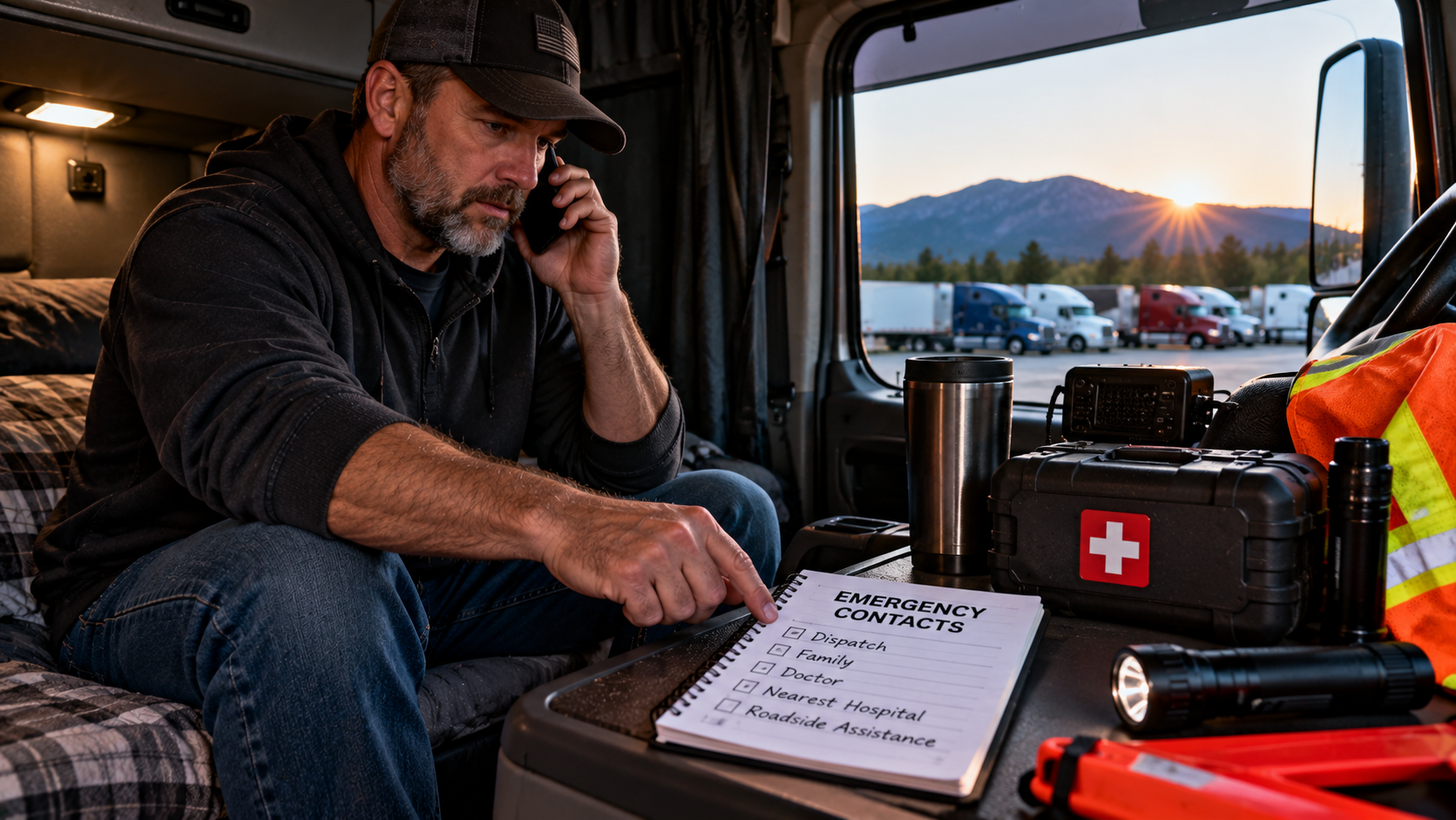
There's a side of trucking that people outside the industry don't always think about.
A professional driver can spend days or weeks on the road, hundreds of miles from home, sleeping in a truck, eating alone, and working without another person nearby.
For plenty of drivers, that independence is part of the appeal.
But there's another side to it.
What happens if you have a heart attack in your sleeper at two in the morning? What if you fall while climbing out of the cab, suffer a medical emergency at an isolated delivery location, or become seriously ill where nobody knows you're in trouble?
Who notices? Who calls for help? And how long might it take before somebody realizes something is wrong?
Those are questions worth answering before an emergency happens.
Working Alone Is Part of the Job
Unlike employees who work in offices, factories, or warehouses surrounded by coworkers, many truck drivers spend much of their working day physically separated from other people.
A driver might communicate regularly with dispatch but still go hours without face-to-face contact.
Over-the-road drivers may spend nights at remote parking locations, rest areas, or customer facilities.
Even local drivers can find themselves working alone at early-morning delivery locations or isolated loading docks.
In October 2026, the National Institute for Occupational Safety and Health (NIOSH) highlighted research examining physical and social isolation across American occupations.
Heavy-truck operations were among the occupations identified as potentially involving substantial physical isolation.
The research does not establish that every truck driver experiences loneliness or that working alone automatically creates a medical emergency.
But it highlights an important occupational reality.
When something goes wrong, a driver may not have another person nearby to recognize the problem or provide immediate assistance.
The Emergency Nobody Sees
Consider a driver parked for the night at a truck stop.
The driver finishes a meal, closes the curtains, and goes to sleep.
Sometime during the night, a serious medical emergency occurs.
There may be no crash, no damaged equipment, no alarm, and no obvious indication to anyone outside the truck.
Other drivers continue coming and going.
The truck remains parked.
Unless the driver can call for help or someone notices an unusual absence, the situation may go undiscovered.
This is why emergency preparedness for professional drivers involves more than knowing where the nearest hospital is located.
It also involves making sure someone knows when to check on you.
A Check-In Plan Can Make a Difference
Most drivers already communicate with someone during the day.
It might be dispatch, a spouse, a family member, or another driver.
But routine conversation isn't necessarily an emergency plan.
A useful check-in arrangement establishes what should happen when expected communication doesn't occur.
For example, a driver and family member might agree to exchange a message at a certain point each evening.
If the driver doesn't respond, the family member knows whom to contact and what information to provide.
A carrier may have its own procedures for drivers who unexpectedly become unreachable.
The important part is having an agreed process rather than assuming somebody will eventually notice.
A missed call doesn't automatically mean an emergency. Drivers lose cellular service, sleep at unusual hours, and work changing schedules.
The response should be reasonable and based on the circumstances.
But repeated unsuccessful contact attempts, combined with an unexpected lack of movement or other concerning information, deserve attention.
Make Sure Someone Knows Where You Are
A truck driver may know exactly where the truck is parked, but that information isn't always available to the people who would need it during an emergency.
A family member might know you're somewhere in Oklahoma without knowing which truck stop or rest area you're using.
Dispatch may have vehicle-location information, but that doesn't necessarily mean your family knows whom to call.
Consider maintaining an emergency contact arrangement that identifies:
Your carrier or dispatch contact information.
Your truck number and relevant equipment information.
Your emergency contacts.
How to communicate your current parking location.
What steps should be taken if you become unexpectedly unreachable.
Location-sharing technology can be useful when voluntarily configured and understood by everyone involved.
But technology should support the plan, not replace it.
GPS information may be delayed, unavailable, or insufficient to identify an exact parking location.
Medical Information That Could Help First Responders
If a driver becomes unable to communicate, emergency personnel may need important medical information.
That can include current medications, significant allergies, relevant medical conditions, and emergency contacts.
Drivers may choose to keep this information in a secure, accessible format or use the emergency medical information features available on many smartphones.
Privacy matters.
There's no need to leave sensitive medical records openly displayed inside the truck.
The objective is to make essential information available to authorized emergency personnel when needed.
Drivers who use prescription medication should also understand how their medications are stored and how to communicate important information during an emergency.
Recognize When Something Is More Than Ordinary Fatigue
Truck driving is physically and mentally demanding.
Long workdays, irregular sleep schedules, extended sitting, and changing meal routines can make it tempting to dismiss symptoms as ordinary exhaustion.
But some symptoms require immediate attention.
Chest pain or pressure, sudden difficulty breathing, signs of a stroke, fainting, severe confusion, or other serious symptoms should not be ignored.
If you believe you're experiencing a medical emergency, stop operating the vehicle as safely as possible and contact emergency services.
In the United States, call 911.
Do not attempt to continue driving to finish a delivery or reach a terminal while experiencing symptoms that could impair your ability to operate safely.
A load can be rescheduled.
A medical emergency cannot always wait.
What If You're Parked Somewhere Remote?
Truck stops and rest areas may have employees, other drivers, and passing traffic nearby.
But not every parking location offers that level of access.
Drivers sometimes stop at remote facilities, isolated lots, or locations where cellular coverage is unreliable.
Before settling in for an extended break, consider whether the location provides reasonable access to emergency assistance.
Know the location's address or highway reference information when possible.
If you need to call 911, being able to identify the nearest exit, mile marker, highway, or facility can help responders locate you.
If you're in an unfamiliar industrial area, the shipping address may not be the same as the entrance or parking area where your truck is located.
Providing accurate location information can be important when minutes matter.
Falls and Injuries Around the Truck
Not every emergency involves a sudden medical condition.
Drivers can be injured while entering or exiting the cab, climbing onto equipment, handling cargo securement devices, or walking around a truck in poor weather.
A slip on an icy step or a fall at an isolated customer facility can leave a driver unable to reach the cab or call for assistance.
Basic precautions remain important.
Maintain three points of contact when entering or exiting the cab.
Use appropriate footwear.
Keep steps and grab handles in good condition.
Avoid unnecessary climbing or unsafe shortcuts.
Carry a charged phone where it can be reached rather than leaving it inside the truck during every outside task.
If you're seriously injured, do not risk worsening the injury by attempting to move unnecessarily.
Contact emergency services or seek assistance.
Your Phone Is Part of Your Emergency Equipment
For a driver working alone, a reliable phone can be an important safety tool.
Keep it charged and accessible.
A charging cable, suitable power source, and backup battery can help reduce the chance of losing communication when you need it.
Learn how to use your phone's emergency calling features.
Some devices offer emergency SOS functions, medical identification information, location sharing, and other safety capabilities.
These features vary by device, network, and location.
They should not be assumed to work everywhere, especially in areas with limited service.
Drivers should understand the capabilities and limitations of the equipment they carry.
What Carriers Can Do
Driver emergency preparedness shouldn't depend entirely on individual drivers.
Motor carriers can establish reasonable procedures for identifying and responding to situations in which a driver unexpectedly becomes unreachable.
Those procedures might include defined escalation steps, current emergency contact information, and clear instructions for contacting local emergency services when there is credible reason to believe a driver is in danger.
Dispatchers should understand the difference between an ordinary communication delay and a potentially serious welfare concern.
A driver who misses one routine message may simply be sleeping.
A driver who unexpectedly stops communicating, misses scheduled activities, and cannot be reached despite repeated attempts may require a different response.
The goal is not constant surveillance.
It's having a sensible process when circumstances indicate that someone may need help.
Don't Forget the Family at Home
Families often know the realities of trucking better than anyone.
They understand that drivers work irregular hours, lose cellular service, and sometimes sleep during the day.
But they may not know exactly whom to contact when something feels wrong.
An emergency plan should identify a carrier contact, the driver's truck number, and any other information that could help locate the driver.
Families should also understand that contacting emergency services may be appropriate when there is a credible concern about immediate danger.
Waiting indefinitely because someone assumes the driver is probably sleeping can create unnecessary risk.
Communication and clear expectations help everyone respond appropriately.
Build a Simple Emergency Plan Before You Need It
A practical plan doesn't have to be complicated.
Start with a few questions.
Who expects to hear from you?
Who should they contact if they cannot reach you?
Does someone know your carrier and truck number?
Can you identify your location accurately when calling for help?
Is your phone charged and accessible?
Would emergency responders have a way to obtain essential medical information if you couldn't speak?
These are straightforward preparations that can become extremely important under the wrong circumstances.
The Bottom Line
Truck driving offers independence that many people value.
But independence shouldn't mean being completely on your own when an emergency happens.
A medical problem, serious injury, or unexpected loss of communication can become more dangerous when nobody knows where you are or when to check on you.
Have a plan. Keep your emergency contacts current. Know how to communicate your location. Make sure somebody understands what to do if you unexpectedly disappear from contact.
Because when you're alone in that truck, the most important backup you can have may be somebody who knows when to come looking for you.
Research and Safety Resources
NIOSH eNews, October 2026: Occupational Isolation Research
CDC: Heart Attack Symptoms
CDC: Signs and Symptoms of Stroke
Ready.gov: Emergency Planning
This article provides general safety and emergency-preparedness education. It does not replace professional medical advice, emergency-response instructions, or a motor carrier's established safety procedures.