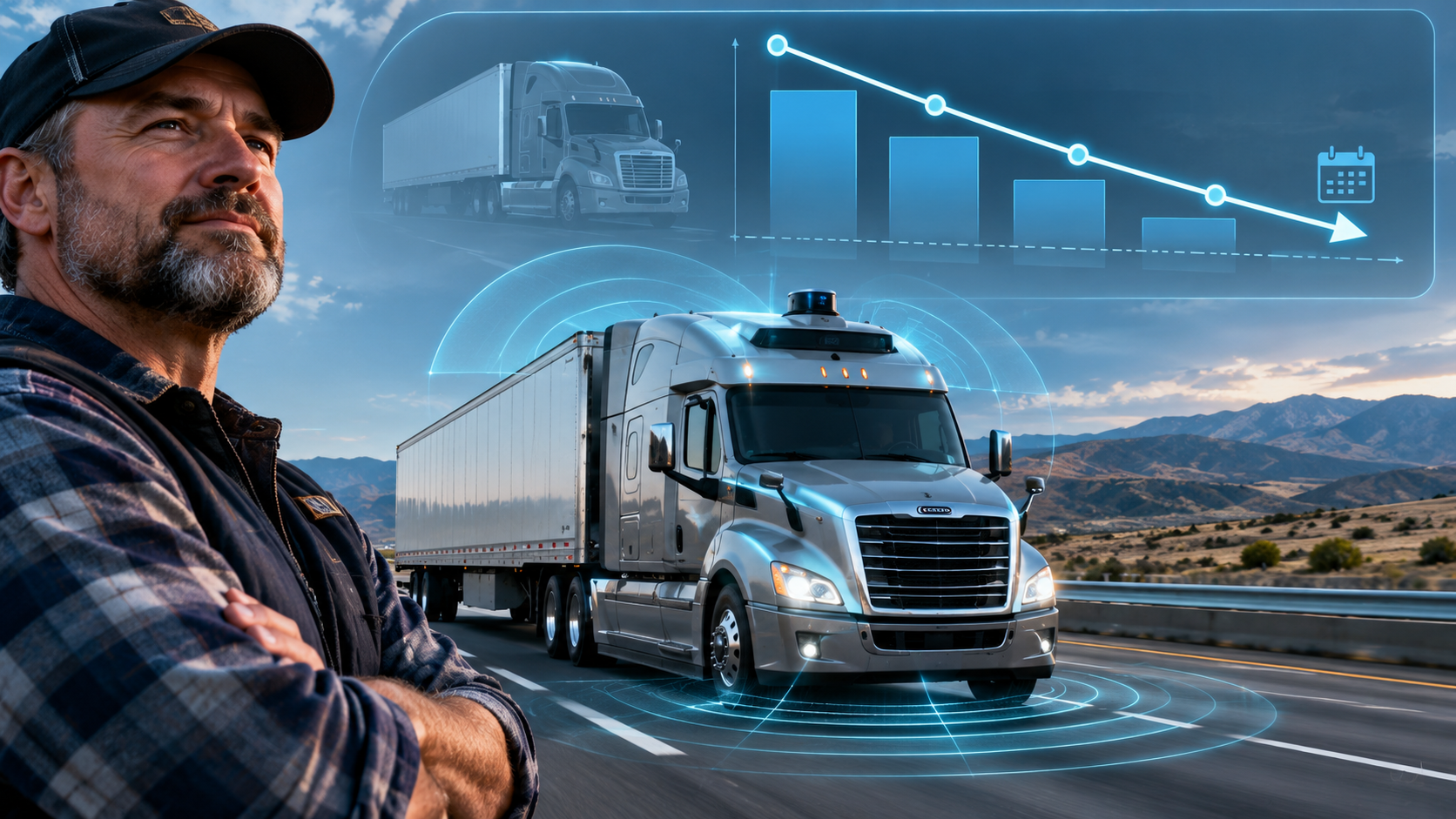
A newly published study from global consulting firm Kearney and the Massachusetts Institute of Technology Mobility Initiative projects that autonomous Class 8 trucks could become cost-competitive with conventional, human-driven trucks in the United States as early as 2028.
The research, released November 5 and examined in a November 10 FreightWaves report, offers a detailed look at the economics behind driverless trucking.
According to the researchers, autonomous trucks currently cost considerably more to operate than conventional trucks. However, improvements in technology, larger fleets, and the ability to spread development expenses across more vehicles could narrow that difference.
The study does not predict that professional truck drivers will disappear in 2028. It estimates when autonomous trucking could become financially competitive under a particular set of economic assumptions.
That distinction matters.
What the Study Found
Kearney and MIT researchers examined the operating economics of autonomous Class 8 trucks compared with conventional trucking operations.
Their projections include:
2026: Autonomous trucking costs approximately $4 per mile, compared with $2.50 for conventional trucking.
2028: Autonomous operating costs could decline to approximately $2.60 per mile, approaching or falling below the projected cost of conventional trucking.
2035: Autonomous operating costs could decline to approximately $2 per mile.
Alternative scenario: Slower autonomous fleet expansion could delay cost parity until approximately 2032.
The findings are based on an economic model informed by more than 25 interviews with autonomous technology developers, truck manufacturers, carriers, brokers, and investors.
These figures are projections, not verified operating costs across the entire trucking industry.
Why 2028 Is an Important Date
The study identifies 2028 as a potential turning point in the economics of autonomous trucking.
Today, driverless equipment requires expensive technology, ongoing development, specialized operations, and additional support systems.
As the number of autonomous trucks increases, those costs could be distributed across a larger fleet.
Researchers estimate that the economics may eventually become competitive with conventional trucking, particularly in the United States, where driver-related expenses represent a substantial portion of long-haul operating costs.
However, cost parity is not the same as widespread commercial adoption.
A technology can become economically competitive before it becomes practical for every carrier, freight lane, or operating environment.
Fleet Size Could Determine the Timeline
One of the most important findings concerns the number of autonomous trucks actually deployed.
The study's projected cost reductions depend heavily on increasing fleet size.
Researchers modeled a scenario in which the autonomous fleet expands to approximately 40,000 trucks by 2035.
That scale would allow development and technology expenses to be distributed across many more vehicles.
However, if deployment reaches only about 10,000 trucks by 2035, the researchers estimate that U.S. cost parity could be delayed until approximately 2032.
In other words, the 2028 projection is not guaranteed.
The economic outcome depends on how quickly the technology develops and how many trucks are placed into commercial service.
What Makes Autonomous Trucking Expensive Today?
Removing a driver from the cab does not eliminate every expense associated with operating a commercial truck.
Autonomous systems require specialized hardware, software, sensors, monitoring systems, and technical support.
The study examines several major operating-cost factors, including:
Vehicle acquisition and equipment expenses.
Autonomous driving technology.
Research and development.
Remote operations and supervision.
Fleet utilization.
Maintenance and other operating expenses.
Driver-related labor costs in conventional trucking.
The researchers also considered how the number of vehicles monitored by remote personnel could change as the technology develops.
These expenses help explain why autonomous trucking remains more expensive in the study's current economic model.
Why the United States Could Reach Cost Parity First
The researchers project that autonomous trucking could become cost-competitive in the United States before reaching the same point in Europe or the Middle East.
A major reason is the relative cost of employing professional drivers.
The study estimates that a fully loaded U.S. long-haul driver costs approximately $10,000 per month when wages and benefits are included.
That figure is a modeled labor expense, not a claim that every truck driver earns $10,000 monthly.
The researchers estimate that driver-related costs represent a significant portion of conventional trucking expenses.
Consequently, the potential economic savings from autonomous operation may be greater in markets where driver labor costs are higher.
Autonomous Trucks Are Already Operating
Autonomous trucking is no longer limited to laboratory testing and closed proving grounds.
Several companies are developing and deploying driverless commercial trucks on selected routes.
FreightWaves reported that Aurora's autonomous trucks have accumulated more than 500,000 driverless miles on public roads.
However, current deployment remains limited compared with the overall U.S. trucking industry.
Most commercial trucking continues to rely on professional drivers, and autonomous operations remain concentrated in specific operating environments and freight corridors.
That is a significant difference between proving the technology on selected routes and operating across the entire national highway network.
Regulatory and Liability Questions Remain
The study also identifies unresolved questions involving government regulation, operational authority, and legal responsibility.
Among the issues requiring further development are:
How autonomous driving systems should be certified.
How driverless operations will be regulated across state lines.
Which companies are responsible when an autonomous vehicle is involved in a collision.
How responsibility is divided among carriers, vehicle manufacturers, and autonomous technology providers.
How autonomous trucks will operate across different jurisdictions.
These questions affect how quickly autonomous trucking can expand beyond its current operating corridors.
Even if the economic model reaches cost parity in 2028, regulatory and operational requirements could influence the pace of deployment.
What Does This Mean for Professional Truck Drivers?
The most important distinction is between economic competitiveness and workforce replacement.
The study projects when autonomous trucks could become less expensive to operate under certain conditions.
It does not establish that autonomous trucks will replace professional drivers nationwide in 2028.
Trucking includes many different types of operations.
Long-haul interstate transportation, local deliveries, specialized freight, construction hauling, hazardous materials transportation, and other services involve different operating requirements.
A system capable of operating on a selected highway corridor does not automatically possess the ability to perform every task handled by a professional driver.
The pace of adoption will depend on the technology, regulations, carrier investment, and the types of freight operations involved.
The study nevertheless provides a significant indication of how major transportation companies and technology developers are evaluating the industry's future.
The Business Question Behind Driverless Trucks
The study examines several competing approaches to autonomous trucking.
Some manufacturers are developing autonomous-capable trucks as part of their vehicle platforms.
Other companies are building specialized autonomous vehicles, operating autonomous fleets, or developing the virtual driving technology used by carriers.
These approaches create different business relationships among truck manufacturers, transportation companies, and technology providers.
The central question is not simply whether a truck can operate without a driver.
It is whether that truck can provide dependable transportation service at a cost that makes commercial sense.
The Kearney-MIT study suggests that the economic answer could change considerably over the next several years.
Sarge's Takeaway
Autonomous trucking has been discussed for years, and much of that discussion has centered on whether the technology can safely operate a commercial truck.
This study examines another question: When does operating a driverless truck become financially attractive to a carrier?
The researchers believe that point could arrive around 2028 under their projected deployment scenario.
But there is a difference between a financial model and the reality of operating trucks across the country.
Freight lanes, equipment requirements, regulatory approval, operational reliability, and the pace of fleet expansion will all influence what happens next.
Professional drivers are not disappearing in 2028 simply because a study identifies that year as a possible economic turning point.
What the research does show is that the financial case for autonomous trucking is becoming a serious part of the industry's long-term planning.
And that is a development worth watching.
Sources and Further Reading
Original research
Kearney Transportation and Travel Research — Gaining Ground with Autonomous Trucking, November 5, 2026.
Independent industry reporting
FreightWaves: Kearney, MIT Put U.S. Driverless Truck Cost Parity at 2028, November 10, 2026.
Reporting note: The financial projections discussed in this article are based on the Kearney-MIT economic model and should not be interpreted as guaranteed future operating costs or adoption dates.